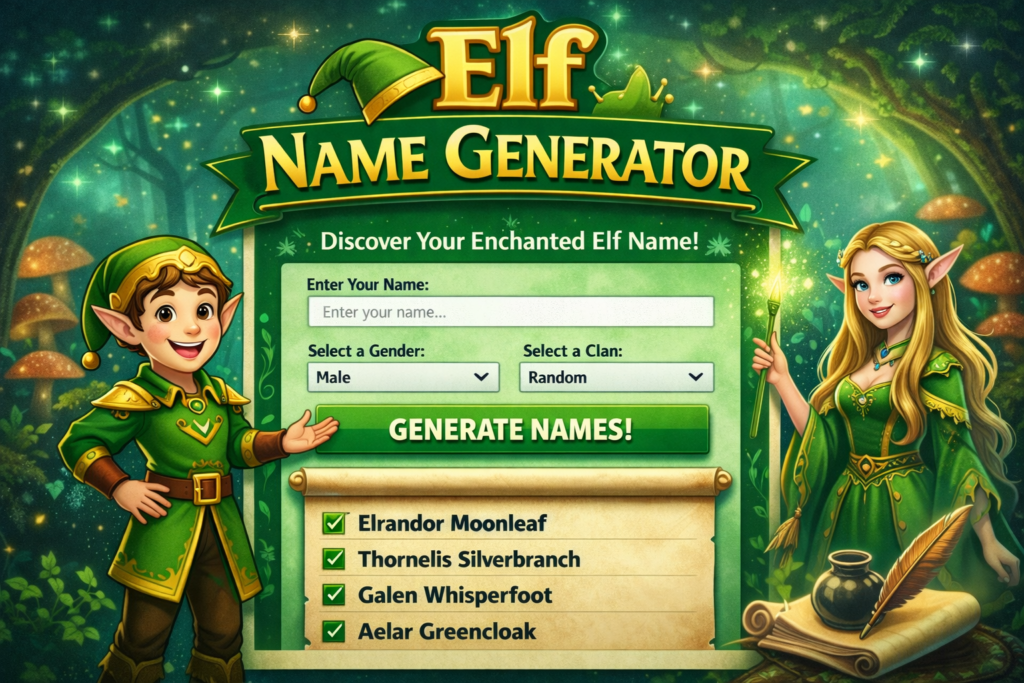
🧝 Elf Name Generator
Discover your mystical elven identity from the enchanted forests
Ready to find your elven identity?
Select your elf type and click generate
The Ultimate Guide to Using an Elf Name Generator: Find Your Perfect Fantasy Name
There is something magical about elves. From ancient folklore to modern fantasy novels, from classic literature to blockbuster films, elves have captured the human imagination for centuries. They are wise, graceful, mysterious, and ancient. And every elf, without exception, carries a name that sounds like it was borrowed from a forgotten language spoken only in enchanted forests under silver moonlight.
If you have ever tried to come up with an elf name on your own, you already know how hard it is. Too soft and it sounds silly. Too harsh and it sounds like a different creature entirely. Too short and it loses the mystical quality. Too long and nobody can pronounce it. This is exactly why an elf name generator exists, and why so many writers, gamers, cosplayers, and fantasy fans rely on one every single day.
This guide covers everything you need to know about elf names, where they come from, what makes them sound authentic, and how to get the best results from an elf name generator every time you use it.
✨ Looking for something funnier? Check out our Hilarious Nickname Generator for completely different, laugh-out-loud names!
The Fascinating History of Elf Names
To understand what makes a great elf name, you first need to understand where the tradition comes from.
Elves in Northern European folklore were supernatural beings connected to nature, light, and hidden knowledge. The Old Norse word for elf was alfr, and these beings were treated with deep respect and sometimes fear. Their names in old stories tended to be short, sharp, and connected to natural elements like light, wind, forest, and stone.
When J.R.R. Tolkien built his world of Middle-earth, he did something extraordinary. He invented entire languages for his elvish races, Quenya and Sindarin, with consistent grammar rules, vocabulary systems, and sound patterns. Names like Galadriel, Legolas, Elrond, and Arwen were not invented randomly. They followed strict linguistic rules and carried real meaning within Tolkien's invented language system.
This is the standard that most people have in their heads when they think of elf names today. Flowing, melodic, slightly unpronounceable at first glance, but beautiful once you figure out the rhythm. A good elf name generator captures this quality by drawing on similar phonetic patterns, even if it is not directly using Tolkien's specific languages.
What Makes an Elf Name Sound Authentic
Not every combination of vowels and consonants sounds like an elf. There is a specific phonetic profile that the human brain associates with elvish names, and understanding it helps you evaluate the results of any elf name generator you use.
The first quality is melodic flow. Elf names tend to alternate between consonants and vowels in a way that creates a smooth, musical sound. Names like Aerindel, Sylvara, Thalion, and Elowen move through the mouth in a way that feels effortless. Hard stops and harsh consonant clusters tend to feel more dwarven or orcish in most fantasy traditions.
The second quality is meaningful roots. The best elf names carry some sense of meaning, even if the listener does not consciously know what the root words are. Aer suggests air or sky. Syl suggests forest or silver. Thal suggests strength or foundation. When an elf name generator uses root-based construction rather than pure random syllable generation, the results feel intentional rather than accidental.
The third quality is appropriate length. Most traditional elf names run between two and four syllables. Shorter names like Gil or Nim work as shortened forms but feel incomplete as full names. Names longer than five syllables start to feel more like titles or ceremonial designations than everyday names.
The fourth quality is gender signaling. In most fantasy traditions, female elf names tend to end in softer sounds – a, el, iel, ara – and male elf names tend to end in harder sounds – on, ion, ir, or – though there is significant overlap and many elf name traditions use gender-neutral constructions deliberately.
Types of Elves and How Names Differ Between Them
One of the most useful features of a well-built elf name generator is the ability to distinguish between different types of elves, because different elvish traditions produce very different name styles.
High Elves are the noble, ancient, often immortal elves of classical fantasy. Their names tend to be the most formal and melodic, drawing on Tolkien's Quenya influence. Names like Aravindel, Calithian, Miriel, and Celeborn fit this tradition. They sound like they belong in marble halls and ancient libraries.
Wood Elves are wilder, more connected to nature and forest living. Their names tend to be shorter and sharper, with more nature-based roots. Names like Sylvan, Greenleaf, Ashbark, Mosswick, and Ferndale fit this tradition. They sound like they belong in treetop villages and moonlit clearings.
Dark Elves, sometimes called Drow in popular fantasy settings, carry names that are harder and more angular. The Drow naming tradition, popularized by games like Dungeons and Dragons, uses a very different phonetic profile. Names like Viconia, Drizzt, Malice, and Zin carry a harsher, more dangerous quality that fits the underground, shadowy culture of dark elf lore.
Sea Elves and Sky Elves, found in various fantasy settings, often carry names that evoke water, wind, and open horizons. Names like Nerindel, Wavecrest, Tidalborn, and Skywarden fit this tradition.
A good elf name generator lets you select which type of elf you are naming, and adjusts its phonetic output accordingly. Our elf name generator above gives you style and category filters that let you steer the results toward the specific tradition you need.
For more deep dive into Tolkien's elvish languages, The Tolkien Society offers excellent resources on Quenya and Sindarin linguistics.
Why People Use an Elf Name Generator
The range of people who need elf names is much wider than most people realize.
Dungeons and Dragons players are probably the largest single group. Every new campaign means a new character, and every elf character needs a name that fits the world the dungeon master has built. The pressure of choosing a name at the table, in front of everyone, with a dungeon master waiting, is real. An elf name generator removes that pressure entirely. You come prepared with several strong options and pick the one that feels right for your character concept.
Fantasy writers need elf names constantly. A novel or short story set in a fantasy world might require dozens of named characters across multiple races. Spending creative energy on name invention pulls focus away from actual storytelling. An elf name generator handles the mechanical part of name creation so the writer can focus on character and plot.
Video game players use elf names for character creation screens in games like World of Warcraft, Elder Scrolls, Final Fantasy, Dragon Age, and dozens of other RPGs. The character creation screen is the first impression your character makes, and a well-chosen name sets the tone for your entire experience with that character.
Cosplayers and LARP participants need names for their personas. A dedicated elf cosplayer at a convention or a LARP participant in a fantasy event needs a name that holds up to scrutiny from other fans. An elf name generator that understands the linguistic rules of elvish naming helps create a persona that feels authentic.
Fantasy sports leagues, online communities, and creative writing groups all have members who adopt elf personas or themes. Even outside of gaming and writing, there is a growing creative culture around fantasy identity that makes elf names relevant to a surprisingly broad audience.
How to Get the Best Results from an Elf Name Generator
Like any creative tool, an elf name generator rewards thoughtful use. Here are the strategies that consistently produce the best results.
Know your elf type before you start. Are you creating a High Elf noble, a Wood Elf ranger, a Dark Elf rogue, or something else entirely? The clearer your concept, the better you can evaluate the names the generator produces. A name that is perfect for a Wood Elf scout might be completely wrong for a High Elf archmage.
Generate in batches. A single generation gives you one perspective. Run the elf name generator five or six times and collect the names that catch your attention across all those runs. You will often find that the best name is not in the first batch at all.
Pay attention to how names feel when spoken. Read each name out loud before committing. Fantasy names that look elegant on screen sometimes feel clunky when spoken. The test of a truly good elf name is that it sounds right when said aloud, not just when read silently.
Mix and match. Some of the best character names come from taking one element from one generated name and combining it with an element from another. If the generator produces Aerindel and Thalvara in the same session, Aelvara might be exactly what you were looking for all along.
Consider the meaning you want to imply. Do you want a name that suggests strength? Look for names with bold consonant sounds. Do you want a name that suggests wisdom or age? Look for longer, more formal constructions. Do you want a name that suggests connection to nature? Look for names with soft, flowing sounds and nature-based roots.
Elf Names Across Different Fantasy Universes
Part of what makes elf naming so interesting is how much the tradition varies across different fantasy settings. Understanding these differences helps you use an elf name generator more effectively for specific contexts.
In Tolkien's Middle-earth, elf names follow the rules of Quenya and Sindarin. Quenya names tend to be more formal and ceremonial, used in ancient contexts and high elvish culture. Sindarin names are more commonly used in daily life and tend to sound somewhat more approachable. Both follow strict phonological rules that Tolkien developed over decades.
In the Forgotten Realms setting used by Dungeons and Dragons, elf names follow a different tradition. Sun Elves, Moon Elves, Wild Elves, and Drow each have distinct naming conventions. The Player's Handbook for D&D provides sample names and naming conventions, and most experienced players try to create names consistent with these guidelines.
In the Elder Scrolls universe, the Mer races, which include Altmer, Bosmer, Dunmer, and others, each have distinct naming traditions that feel quite different from Tolkien's influence. Altmer names tend to be long and formal. Dunmer names often carry a darker, harsher sound. Bosmer names tend to be shorter and more nature-connected.
In original fantasy worlds created by writers and game designers, the elf naming tradition is whatever the creator decides it is. This is where an elf name generator becomes especially valuable, because it provides a starting point that feels authentic even when there is no established canon to follow.
Building a Complete Elf Identity Around Your Name
A great name is the foundation of a great character, but it is not the whole structure. Once you have found your perfect name through an elf name generator, here is how to build a complete elf identity around it.
Consider the meaning your name implies and let that shape your character concept. If your name suggests sky or wind, maybe your character has abilities or interests connected to weather magic or aerial movement. If your name suggests shadow or night, maybe your background involves stealth or a complicated relationship with darkness.
Think about how your character introduces themselves. Elves in most fantasy traditions have personal names, family names, and sometimes earned titles or epithets. A full elf identity might include all three. Your generated name might become the personal name, and you can build the rest from there.
Consider how your name sounds to other characters in your world. A High Elf walking into a tavern full of humans will introduce themselves differently than when standing before an elven council. The name stays the same but the context of using it changes.
Let the name inform personality choices. A character named something sharp and angular will feel slightly different to play than one named something flowing and melodic, even if the stats on the character sheet are identical. Good roleplayers let the name influence how they inhabit the character.
Why Our Elf Name Generator Is the Right Tool
The elf name generator at the top of this page is designed with the same philosophy that makes the other tools on this site worth using. It draws on a deep database of authentic-feeling name components, applies phonetic rules that produce melodic and believable results, and gives you enough options in each generation session to find something genuinely useful.
The tool works without barriers. No account needed, no email required, no paid tier blocking the best results. You arrive at the page, select your preferences, and generate names immediately. For writers on deadline, players at character creation, and cosplayers planning a convention appearance, this frictionless experience matters.
The variety of outputs also means the elf name generator is useful across multiple sessions. Running it for a new campaign after already using it for a previous one will produce a completely different set of results, keeping the creative well from running dry no matter how many times you return.
Final Thoughts
Elf names carry weight. In every fantasy tradition, from the oldest folklore to the newest video game, the name of an elf character signals something about who that character is, where they come from, and what kind of world they inhabit. Getting that name right matters more than most people realize until they have spent an hour staring at a blank character sheet.
An elf name generator removes the blank page problem. It gives you material to react to, names that feel close but not quite right, names that spark a better idea, and occasionally a name that is exactly perfect from the moment you read it. The tool does not replace your creative judgment. It gives your creative judgment something to work with.
Whether you are a first-time D&D player trying to name your debut character, a novelist building a fantasy world from scratch, or someone who just wants to know what their name would be if they lived in an enchanted forest, use the elf name generator above and let it do what it does best.
Your elvish name is waiting. It has been waiting in the forest for quite a long time, actually. It is very patient. It is an elf name, after all.
Frequently Asked Questions
✨ Want more naming fun? Try our Hilarious Nickname Generator for completely different, laugh-out-loud names!